Skip the App Store: Why Developers Are Betting Big on AI Platforms Instead

Photo: developer coding laptop with AI chatbot interface on screen, via thumbs.dreamstime.com
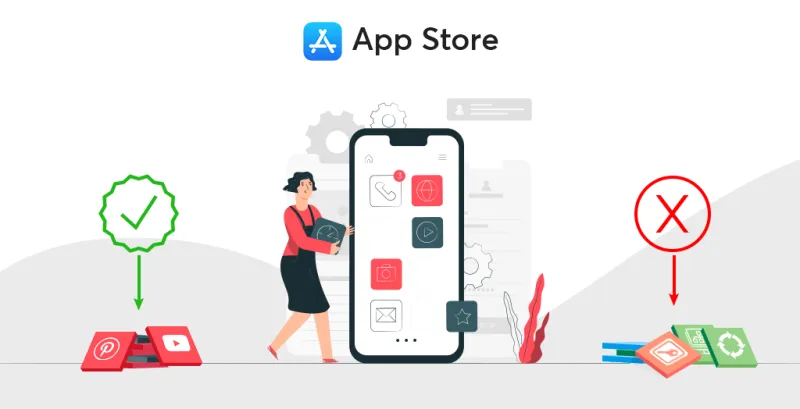
For the better part of two decades, getting your app in front of users meant one thing: surviving the App Store or Google Play. You optimized your screenshots, sweated over your keyword strategy, prayed your review didn't get rejected for some vague policy violation, and handed over 30% of your revenue to a platform that didn't lose a minute of sleep over your success.
That deal is starting to look a lot less attractive — and a growing number of developers are walking away from it entirely.
The destination? AI assistants. Platforms like ChatGPT, Claude, Perplexity, and a rising wave of AI-native tools are quickly becoming the new frontier for software distribution. And the developers moving there aren't doing it out of frustration alone. There's real economic logic behind the exodus.
The Math Has Stopped Making Sense
Let's be honest about what traditional app store distribution actually costs. Apple and Google each take a cut that starts at 15% for small developers and jumps to 30% for anyone doing meaningful volume. That's before you factor in the cost of user acquisition — which, in a saturated app market, has become eye-wateringly expensive.
According to data from AppsFlyer, the average cost to acquire a single paying user in the US has climbed steadily year over year, with some categories running well north of $40 per install. For a $4.99 app, that math simply doesn't work. For a subscription app with churn? It barely gets better.
Contrast that with building a plugin or integration for an AI platform. You're not paying for discovery — the users are already there, already in a problem-solving mindset, and already trusting the assistant to surface the right tool at the right moment. The distribution model is fundamentally different, and for many use cases, dramatically cheaper.
What "Building for AI" Actually Looks Like
When developers talk about building for AI platforms, they're not necessarily talking about building AI itself. They're talking about building within AI ecosystems.
OpenAI's plugin and GPT Action framework lets developers connect external services directly into ChatGPT's workflow. Anthropic's Claude supports tool use that allows third-party integrations to extend what the assistant can do. Perplexity has been actively courting developers to build on top of its search-and-answer infrastructure.
In practice, this means a travel tool that surfaces inside a ChatGPT conversation when someone asks "find me a flight from Chicago to Miami next Thursday." Or a legal research integration that activates when a lawyer asks Claude to pull relevant case precedents. The app doesn't live on a home screen — it lives inside the conversation.
For certain categories of software, this is a genuinely better user experience. There's no download friction, no onboarding flow to abandon, no push notification permissions to grant. The tool just works when you need it.
The Discoverability Problem Is Flipping
One of the persistent headaches of app store distribution has always been discoverability. With millions of apps competing for attention, getting found organically is nearly impossible without either spending aggressively on ads or getting featured — which is largely outside any developer's control.
AI platforms invert this problem in an interesting way. Instead of users searching for your app, your integration gets surfaced contextually by the AI when it's relevant. That's a fundamentally different — and in many ways more powerful — form of discovery.
It's not perfect. AI platforms have their own gatekeeping, their own approval processes, and their own ways of favoring certain integrations over others. But developers who've made the jump describe the dynamic as feeling less like shouting into a void and more like being in the right room at the right time.
Not Every App Can Make This Move
It would be overly simplistic to declare the app store era dead. It isn't. Games, social platforms, camera tools, fitness trackers — entire categories of software depend on native device capabilities, persistent background access, and hardware-level integrations that no AI assistant can replicate today.
Your favorite running app isn't going to become a ChatGPT plugin. Neither is TikTok.
But for productivity tools, research utilities, data aggregators, scheduling software, and anything that lives primarily in the realm of information retrieval and action-taking? The calculus is genuinely shifting. These are exactly the categories where AI assistants thrive — and exactly where standalone app downloads are starting to feel redundant.
The Platform Risk Nobody's Talking About
Here's the uncomfortable flip side that doesn't get enough attention: trading Apple and Google's platform risk for OpenAI's or Anthropic's platform risk isn't obviously a better deal in the long run.
Developers who built their businesses on Facebook's platform learned a brutal lesson when the algorithm changed and their organic reach evaporated overnight. Developers who went all-in on Alexa Skills found themselves stranded when Amazon quietly deprioritized the whole initiative. The history of tech is littered with third-party ecosystems that got the rug pulled.
AI companies are still figuring out their business models. They're still burning cash at scale. Their policies around third-party integrations are young and untested under real competitive pressure. Betting your entire business on one of these platforms right now requires a certain tolerance for uncertainty that not every developer has — or should have.
The smart play, at least for now, probably isn't a wholesale abandonment of traditional distribution. It's a diversification of where you show up.
What This Means for the App Store's Future
Apple and Google aren't blind to what's happening. Both companies have been making conspicuous moves into AI — Apple Intelligence, Google Gemini's deep Android integration — precisely because they understand that the interface layer is shifting. If the conversation becomes the primary way users interact with software, then controlling the conversation becomes the new platform battleground.
Whether they can pull it off is an open question. Apple in particular has a mixed track record with AI, and Siri's reputation as the butt of every voice assistant joke is going to take serious rehabilitation. Google has more credibility in the space but faces its own structural tensions between protecting search revenue and genuinely embracing AI-first interaction.
What's clear is that the app store model — submit, review, distribute, monetize — is no longer the only game in town. For the first time in a long time, developers have a meaningful alternative. And enough of them are taking it seriously that the traditional platforms can't afford to ignore what's happening.
The app store isn't going anywhere tomorrow. But the developers who built it into what it is today? Some of them are already looking for the exit.